
Mental Health &Psychology Resourcesfor Pakistan
Evidence-based guides and practical resources for anxiety, depression, stress, burnout, OCD, ADHD, relationships, and emotional wellbeing — written for people in Pakistan and South Asian communities.
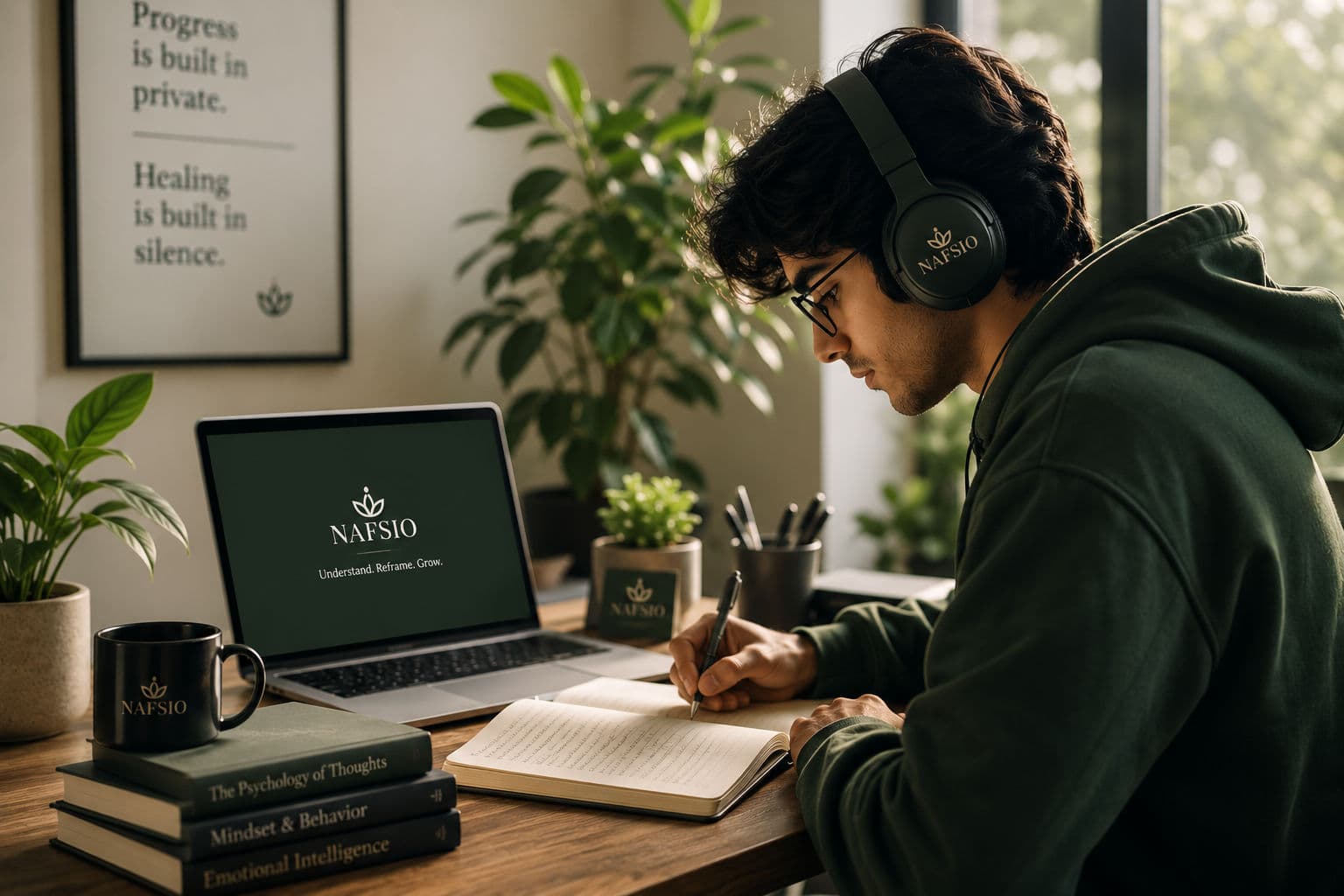
What are you experiencing?
Select a topic to explore evidence-based resources
How It Works
Learn
Read structured, science-backed psychology content.
Understand
Understand your thinking patterns and cognitive biases.
Reflect
Use journaling and self-analysis tools to track emotional states.
Engage
Join public or private community discussions securely.
Support
Ask questions or book structured guidance when needed.
How Nafsio Helps.
Moving from confusion to structural clarity through science and community.
Understanding the Brain
Learn how thoughts form, why anxiety happens, and how neural patterns shape behavior.
Structured Learning
Deep psychology-based articles covering depression, anxiety, trauma, and emotional regulation.
Cognitive Tools
Practical frameworks that help reframe thoughts: stress mapping, decision clarity, emotional labeling.
Community System
Open discussions for shared experiences and private anonymous spaces for structured guidance.
Human Support Layer
Ability to ask questions privately and find guidance toward coping strategies.
Care Access
Users can connect with professionals or mentors when needed.
"Seeking care for the mind is a return to our deepest holistic heritage."
Mental health is not a "Western" import. It is thoroughly historically Islamic.
✦ The First Psychiatric Wards
The world's very first specialized psychological wards and hospitals (Bimaristans) were built by Muslims in cities like Baghdad (705 CE), Cairo, and Damascus. They were funded by community endowments (Waqf), making mental healthcare free and accessible to all.
✦ No Stigma of Weak Faith
Scholars like Al-Balkhi, Al-Razi, and Ibn Sina explicitly taught that mental illness was a physiological imbalance, not a spiritual failure or divine punishment. They recognized that even the most devout believers could suffer from intense emotional pain.
✦ Pioneering Holistic Treatments
Medieval Islamic hospitals did not just isolate patients; they treated them using holistic therapies such as music, bath houses, aromatherapy, storytelling, and cognitive discussion—methods we consider advanced today.
Ahmad ibn Sahl al-Balkhi (9th Century)
The brilliant polymath and author of Masalih al-Abdan wa al-Anfus (Sustenance of the Body and Soul). He was centuries ahead of modern science, firmly establishing the concept of Nafs (the psychological self) and successfully classifying depression into precise clinical categories:
- ▪Nafisani (Endogenous):Depression originating from internal bodily chemistry without external cause.
- ▪Aradi (Reactive):Depression induced by external environment, profound grief, or severe financial loss.
Frequently Asked Questions
Clear, evidence-based answers to common questions about mental health and how NAFSIO supports your emotional wellbeing.
Anxiety is a natural response to stress, characterized by feelings of fear, dread, and uneasiness. However, when these feelings become overwhelming, persistent, and interfere with daily life, it may indicate an anxiety disorder. Common symptoms include excessive worrying, restlessness, increased heart rate, and difficulty concentrating.
// Zero Real-Name Requirement
Legal & Policies
Transparency and trust are fundamental to Nafsio. Review our comprehensive legal policies below.
Privacy Policy
How we collect, use, and protect your data.
Terms & Conditions
The rules governing your use of the Nafsio platform.
Cookie Policy
Information about how we use tracking technologies.
Account Deletion
How to permanently remove your data and account.
Community Guidelines
Our expectations for a safe and respectful environment.
Professional Disclaimer
Important medical and professional boundaries.
Refund Policy
Our policies regarding billing and session refunds.